
Winnipeg Has Two Chambers Band 1 Business Law Firms. AI Ranks One First and the Other Fourth.
We asked ChatGPT, Google and Perplexity 47 questions Winnipeg business clients actually ask. Five firms took more than half of every mention, and a Band 3 firm came second.
Winnipeg law firms are already being ranked by AI. Few of them are watching.
We asked ChatGPT, Google AI Overviews, and Perplexity 47 questions that Winnipeg business owners actually ask. Who handles shareholder disputes? Which firms know corporate governance? Where to go when a commercial lease needs a second look.
Five firms took just over half of every mention. The other 135 firms the engines named split what was left.
That much you'd expect. What you might not expect is the order.
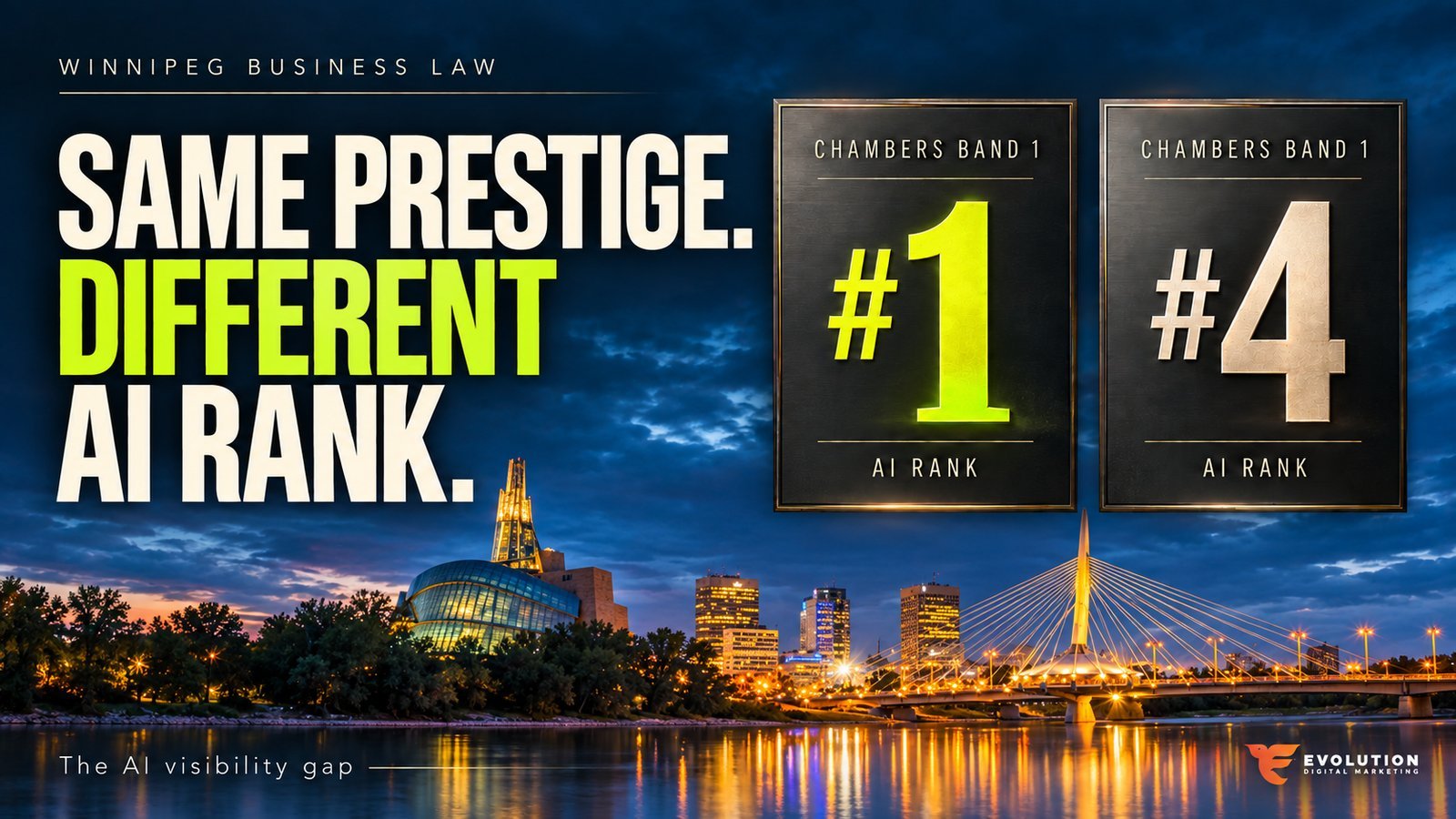
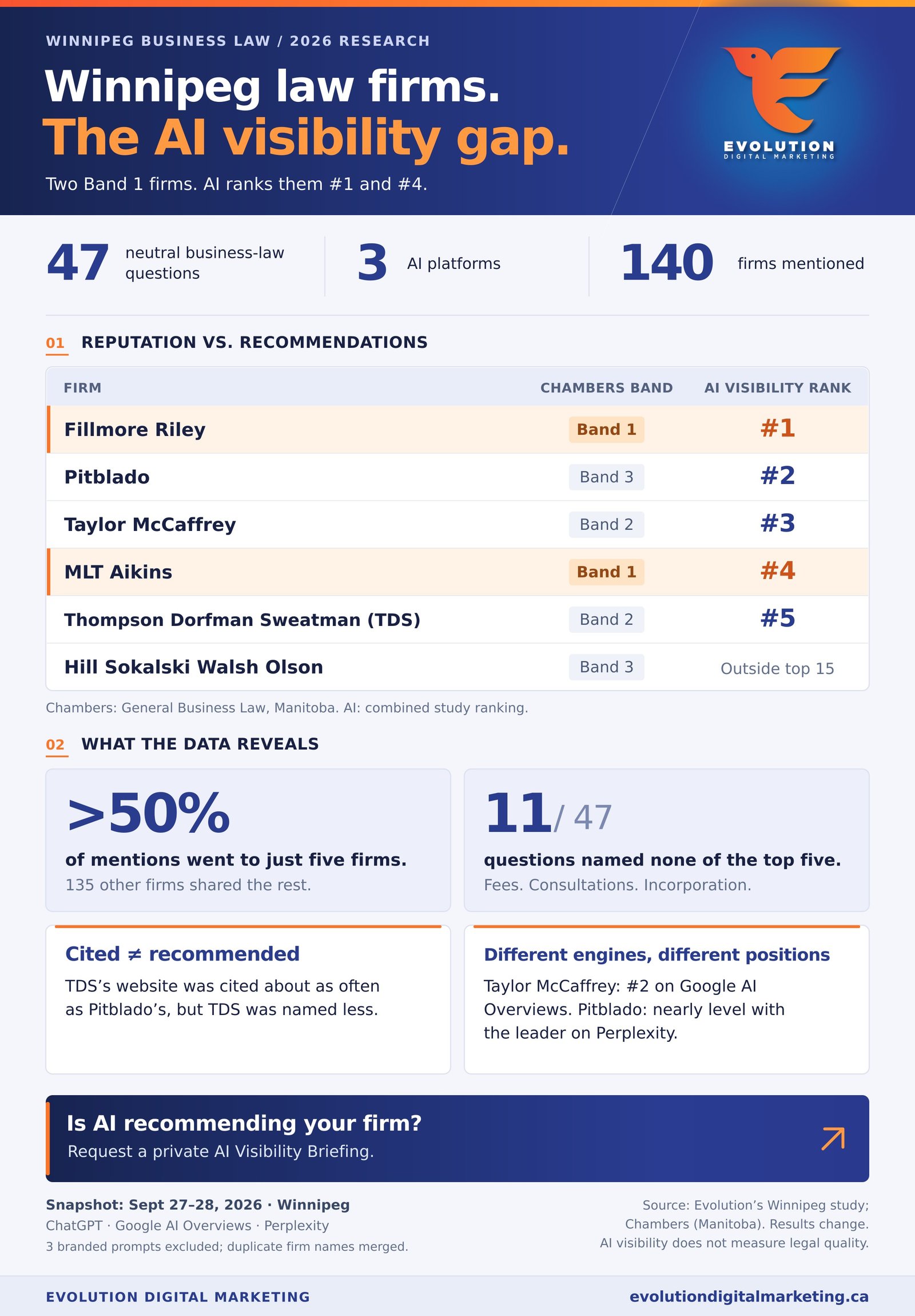
Chambers Canada ranks two Winnipeg firms in Band 1 for General Business Law: Fillmore Riley and MLT Aikins. AI put Fillmore Riley first. It put MLT Aikins fourth. And Pitblado, which Chambers places in Band 3, came second.
Chambers and the AI engines are keeping different scoreboards. Here's where they split, and why.
Two scoreboards, side by side
Chambers asks clients and lawyers who is good. AI engines answer a different question: who can I find, read, and trust enough to name? Those should produce the same list. In Winnipeg, they don't.
| Firm | Chambers band (General Business Law, Manitoba) | AI visibility rank |
|---|---|---|
| Fillmore Riley | Band 1 | 1st |
| Pitblado | Band 3 | 2nd |
| Taylor McCaffrey | Band 2 | 3rd |
| MLT Aikins | Band 1 | 4th |
| Thompson Dorfman Sweatman (TDS) | Band 2 | 5th |
| Hill Sokalski Walsh Olson | Band 3 | Outside the top 15 |
One Band 1 firm leads. The other sits fourth. A Band 3 firm sits second, and another Band 3 firm barely shows up at all. The rankings measure different things, and only one of them is what a new client sees first.
What we found
1. AI has a shortlist, and it has five names on it
Fillmore Riley, Pitblado, Taylor McCaffrey, MLT Aikins, and TDS took just over half of every firm mention across all three engines. That is five firms out of 140. The national firms with Prairie offices barely register: Gowling, Cassels, Blakes, Osler, Dentons, and the rest add up to about 4% combined.
When a business owner asks AI for a Winnipeg firm, the list is short.
2. Reputation does not decide the order
MLT Aikins holds Band 1 in Chambers. It ranks fourth in AI answers. Pitblado holds Band 3. It ranks second.
The engines are not judging legal skill. They aren't built to. They judge what they can read: practice pages that answer the question directly, lawyer profiles with clear credentials, and third-party sites that confirm both. The firm that makes itself easiest to understand gets named first.
3. Being read is not the same as being recommended
TDS has one of the most-cited websites in the study. Its pages are used to build AI answers about as often as Pitblado's. Yet TDS is named in far fewer of those answers.
The engines read the work. Then they recommend someone else.
That's the gap to watch. You do the work of informing the answer, and another firm gets the credit. Closing it is what generative engine optimization is for.
4. Directories are doing a lot of the choosing
Best Lawyers shows up as a source in roughly a quarter of the AI answers in this study. Best Law Firms is close behind. Chambers appears in about one answer in eight. One Canadian Lawyer article, a Top 10 Prairie Law Firms list, turns up again and again.
For some firms, those directory pages carry most of the load. When a firm's own site is thin, the engines lean on whatever someone else has written about it. That works until the directory changes.
5. Each engine keeps its own list
Fillmore Riley leads clearly on ChatGPT. On Google's AI Overviews the lead narrows and Taylor McCaffrey moves up to second. On Perplexity, Pitblado runs almost level with the leader.
No firm holds the same position everywhere. A firm that says it ranks first in AI is describing one engine on one day.
6. The biggest firms are missing from the "I need help now" questions
In 11 of the 47 questions, none of the five were among the firms AI named. Those questions had something in common. They were about price, free consultations, small-business incorporation, and getting a real estate deal done.
Those answers went to boutique firms: TLR Law, PKF Lawyers, Sullivan McMullan, Amica Law, Contrast Law. When we asked Google for top-rated corporate lawyers for small business in Winnipeg, its AI answer listed TLR Law, Chahal & Arora, and PKF Lawyers, with star ratings and street addresses. No large firm made the list.
The big firms own the prestige questions. The boutiques own the questions people ask when they're ready to hire.
7. Seven questions, and no Winnipeg firm at all
Some questions got a full, useful answer and no firm named. "What does a unanimous shareholder agreement actually protect?" was one. Several common questions about incorporation and protecting intellectual property across provinces went the same way.
Nobody in Winnipeg has claimed these yet. That is an open lane for whichever firm moves first.
The findings on one page
What the ABA says, and what Winnipeg shows
In the March/April 2026 issue of Law Practice Magazine, Gyi Tsakalakis took a hard look at AI search for law firms. He is not a cheerleader. He calls out the tricks, the tracking tools, and the promises. "Guarantees and certainty are red flags in this context," he writes.
We agree with him.
His numbers are sober too. Research he cites with Near Media found 54% of people still start legal research on Google. 13% use an AI tool. Fewer than 2% would use AI to find a lawyer today.
But look at what he tells firms to do. Get into the directories that matter: Best Lawyers, Chambers, the review sites. Give every lawyer a clear bio with credentials. Write practice pages that answer the question in plain words, near the top. Keep the firm's name and details consistent everywhere.
That lines up closely with how the Winnipeg shortlist sorts itself. The firm at the top has practice pages the engines quote directly. The firm in third leans on directories. The firm in fifth has content the engines use but a name they don't attach to it.
Read his checklist next to the Winnipeg data and you can see which firms have already worked through it.
What this means for Winnipeg law firms
There's no evidence yet that any firm on this list is losing clients to AI. The ABA's numbers suggest it's early, and we won't pretend otherwise.
The shortlist is being written now, though. Every question a client asks an engine this year adds to what it believes about who does what in Winnipeg. Positions are cheap to take while the list is forming. They get expensive once it settles. If you want your firm on that list, our Winnipeg SEO work is where we start.
From the outside, none of these positions look planned. They read like side effects of work done for other reasons: directory listings, award announcements, practice pages written for Google. That matters, because a position you got by accident is a position you don't know how to defend.
Each of the five firms has a different reason for sitting where it does. One leads on its own content and has gaps it hasn't closed. One is held up by directories. One is read but not named. One shares the top peer ranking in the province and doesn't get the same credit for it. Each one has a different fix.
For firms that want to hold or take a place on this list on purpose, that is the work we do through AI search optimization. We build it from the same signals the engines already reward. We won't promise a ranking, because nobody honestly can. We will show you what the engines are responding to and build your position around it.
A private AI Visibility Briefing
We've prepared a short section for each of the five firms named here. Briefings are open to those firms through October 31, 2026.
If your firm appears in this research, we'll walk you through your section in private. Thirty minutes. Where you stand on each engine, why you're there, and the three moves that would change it.
You'll see your firm's own data, question by question.
To book one, request your briefing here.
How we did this
We tracked 50 questions about Winnipeg business law on an AI visibility tracking platform across ChatGPT, Google AI Overviews, and Perplexity, with location set to Winnipeg. Three of those questions named a specific firm, so we removed them. That left 47 neutral questions, the kind a business owner asks before choosing a firm.
The questions cover business law, corporate governance, shareholder agreements, commercial real estate, intellectual property, regulatory compliance, and startups. Responses were collected on September 27 and 28, 2026.
AI answers change from day to day. Treat this as a snapshot, not a permanent ranking. Where one firm appeared under two names (Thompson Dorfman Sweatman and TDS Law, for example), we combined them. Chambers bands are taken from the current Chambers General Business Law ranking for Manitoba.
Sources
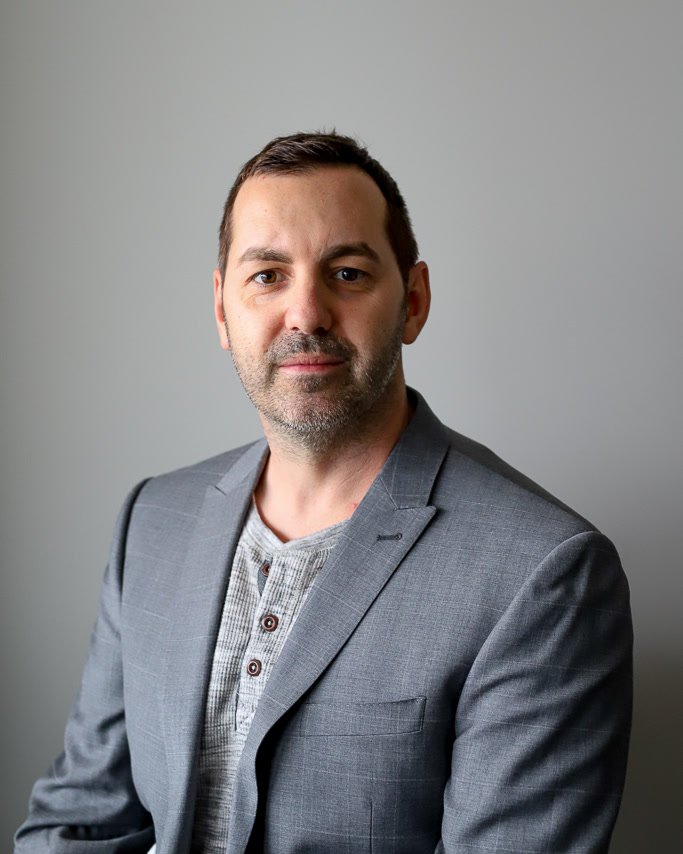
Founder of Evolution Digital Marketing and an AI visibility and SEO specialist. He has been doing SEO since 2012, with roots in semantic SEO and entity optimization, and now works on getting Canadian businesses named in ChatGPT, Perplexity and Google's AI answers.
About Steve